LLM SEO: What It Is, How It Works, and the Data
LLM SEO is the practice of getting your content surfaced by large language models — cited inside ChatGPT and Perplexity answers, not just ranked on Google. Here's the working definition, the two ways your pages actually reach a model, whether your content becomes training data, and what moves the needle.
LLM SEO is the practice of getting your content surfaced by large language models — named and cited inside answers from ChatGPT, Perplexity, Gemini and Google’s AI Overviews, instead of only ranked on a traditional results page. It overlaps with classic SEO, but the target is different: you’re optimizing to be the source a model reaches for and quotes, not the tenth blue link a human might click.
The term gets used loosely. People say “LLM SEO,” “GEO,” “AEO” and “AI SEO” almost interchangeably, and the muddle is a problem in its own right — if you can’t say crisply what you’re optimizing for, you can’t tell whether it worked. So before the tactics, the definitions.
LLM SEO vs. traditional SEO vs. GEO
These aren’t three competing disciplines. They’re three layers of the same job.
- Traditional SEO optimizes for a ranking. The unit of success is a position on a SERP, and the payoff is a click.
- GEO (generative engine optimization) — also called answer-engine optimization — optimizes for a citation. The unit of success is your page being named inside a generated answer. We covered the full working definition in What Is GEO?.
- LLM SEO is the broader umbrella: making your content legible, retrievable and trustworthy to large language models in all the places they appear — chat answers, AI Overviews, agentic browsers, and the model’s own internal sense of who’s authoritative on a topic.
In practice the three collapse into one workflow. The same things that make a page genuinely good for a reader — a clear claim stated plainly, corroborated facts, a recognizable author — are what make it citable by a model. The difference is that an LLM has no patience for fluff and no loyalty to your domain. It extracts the answer and moves on.
The two ways your content reaches a model
This is the part most “LLM SEO” advice skips, and it’s the part that decides which tactics are worth your time. Your content can influence a model’s answer through two completely different pathways, and they behave nothing alike.
Pathway one — the training corpus. When a model is trained, it ingests a huge crawl of the web. Some of your writing may be in there, and it shapes the model’s latent sense of what’s true and who’s an authority. But this pathway is slow and largely out of your hands: it’s frozen at training time, it doesn’t update when you publish, and no single page is decisive. You don’t “rank” in training data — you contribute a drop to an ocean.
Pathway two — live retrieval. When ChatGPT browses, when Perplexity answers, when an AI Overview assembles itself, the system runs a real search at answer-time, pulls a handful of pages, and grounds its response in them — with links. This is the pathway you can win this quarter. It rewards being crawlable, having the answer stated extractably near the top, and being the corroborated source other pages already point to. Almost everything actionable in LLM SEO is really retrieval optimization.
Keep the two separate in your head. Most disappointment with “AI SEO” comes from expecting training-corpus permanence from tactics that only affect live retrieval, or vice versa.
Does your SEO content become LLM training data?
Short answer: some of it probably does, and you have less control over that than the hype implies.
Major models are trained on web-scale crawls — Common Crawl and similar — so if your pages are public and indexable, a slice of your content has likely been swept into one corpus or another. That sounds exciting until you remember the three catches. First, you can’t verify it; there’s no dashboard showing “your site contributed X to model Y.” Second, you can’t update it; a correction you publish today won’t reach a model that finished training last year. Third, you’re one source among billions, so no single article moves the model’s worldview.
What you can influence is whether the model, at answer-time, retrieves and trusts you — and, over the longer arc, whether your name and your claims show up consistently enough across the web that they survive into the next training run as a pattern rather than a one-off. That’s the honest version of “optimizing for LLM training data”: you don’t submit content to a model, you build an entity footprint repeated in enough independent places that the corpus can’t help but encode it. We unpack that mechanism in Entity SEO: How AI Engines Decide Who to Trust.
What actually moves the needle
Strip away the novelty and the working levers are unglamorous:
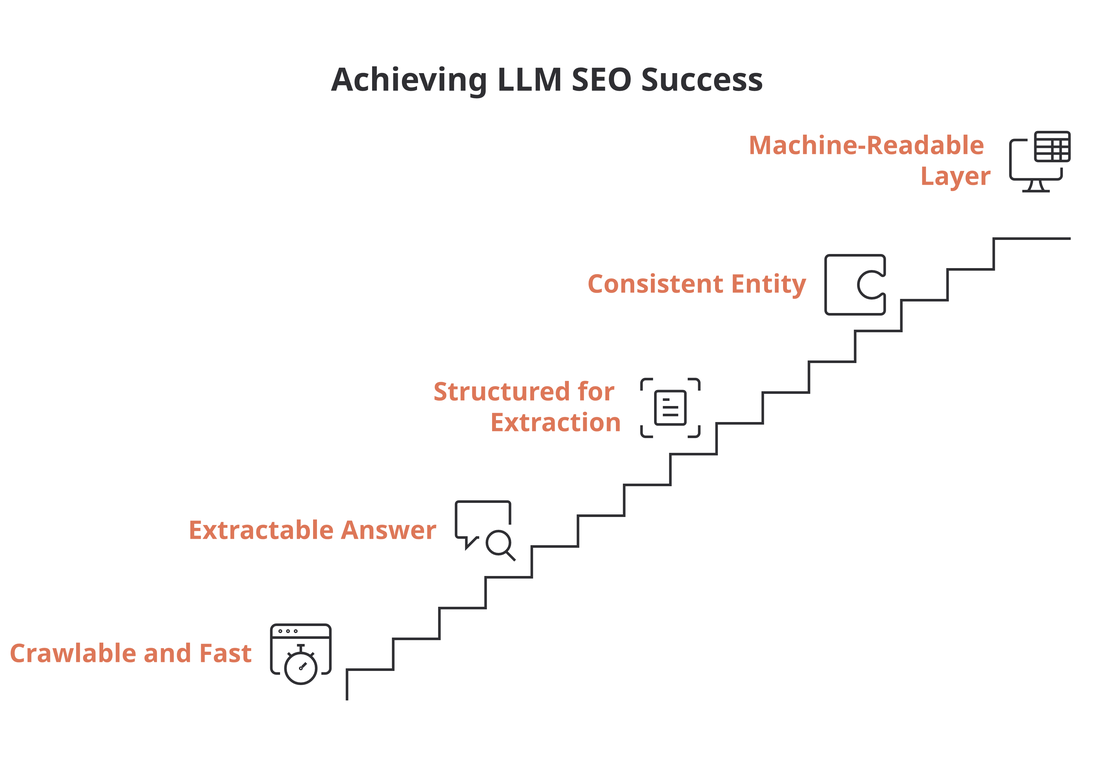
- Be crawlable and fast. If a retrieval bot can’t fetch and parse the page cheaply, none of the rest matters. Google’s own agentic browsing score is a preview of this scrutiny.
- State the answer extractably. Put the claim in the first sentence of the section, in plain language, before the throat-clearing. A model lifts a clean sentence; it won’t reconstruct one buried in a story.
- Structure for extraction. Real headings, short definitional openers, and genuine Q&A blocks give a retriever clean units to quote. This is also why FAQ-style sections punch above their weight.
- Build a consistent entity. Same author, same bio, same claims, corroborated on other people’s sites. Models cite entities they can resolve and trust, not anonymous pages.
- Ship the machine-readable layer. Structured data, a clean
llms.txt, and markdown alternates lower the cost of understanding your page. We walked through the practical setup in Structured Data for the AI-Search Era.
Notice what’s missing: keyword density, exact-match anchors, and word-count padding. LLM SEO punishes the things late-stage traditional SEO over-rewarded.
What we’re seeing on our own site
We don’t run this as theory. RankingHacks dog-foods its own GEO advice, and the data is mixed in a way worth being honest about. Our self-audit scored the site 59/100 — solidly mid-table, with the gaps exactly where you’d expect for a small publisher: entity corroboration and off-site mentions. On the upside, Perplexity and ChatGPT already cite a handful of our pages by name on the topics where we’ve gone deep — the context-density framework, Koray’s topical maps, Kyle Roof’s AI-era playbook — which is the live-retrieval pathway working as advertised.
The frustrating part is the same one every small site hits: being cited is not the same as being clicked. AI answers can name you and still send near-zero traffic, because the user got what they needed inside the answer. That’s the real strategic problem of LLM SEO in 2026, and it’s why the smart move is to pair citation work with an owned audience you actually control. Citations build the brand; the email list captures the value.
My take
LLM SEO isn’t a new discipline you have to learn from scratch — it’s traditional SEO with the padding stripped out and the trust bar raised. If you’ve been writing genuinely useful, clearly-structured, well-attributed content, you’re most of the way there. If you’ve been gaming a ranking algorithm with thin pages and keyword tricks, models are far less forgiving than Google was.
For a solo publisher, the move is not to chase every AI platform at once. It’s to pick the handful of topics where you can be the deepest, most corroborated source on the open web, state your answers plainly enough to be quoted, and make sure that when an AI engine does cite you, there’s a way for that reader to stick around. Citability is earned the slow way. The shortcut is the part that doesn’t work.
Frequently asked questions
What is LLM SEO?
LLM SEO is the practice of optimizing content so large language models — ChatGPT, Perplexity, Gemini, Google’s AI Overviews — surface and cite it in their answers. It extends traditional SEO from “rank on a results page” to “be the source a model reaches for and quotes.”
Is LLM SEO the same as GEO?
They’re closely related. GEO (generative engine optimization, also called AEO) specifically targets being cited inside a generated answer. LLM SEO is the broader umbrella covering all the ways your content reaches a model — live retrieval, training data, agentic browsing, and the model’s internal sense of authority.
Does my content become LLM training data?
If your pages are public and indexable, some of your content has likely been included in the web-scale crawls used to train major models. But you can’t verify it, you can’t update it after the fact, and no single page is decisive — so the reliable lever is live-retrieval optimization, not trying to inject content into a training set.
How do I get my site cited by ChatGPT or Perplexity?
Be crawlable and fast, state the answer plainly near the top of each section, structure content for extraction, and build a consistent, corroborated entity so the model can resolve and trust who you are. We cover the full playbook in How to Get Cited by ChatGPT & Perplexity.