Koray Tuğberk Gubur’s Advanced Strategies for Topical Maps in SEO
Introduction In his presentation “How to Create a Killer Topical Map,” Koray Tuğberk Gubur delved deep into the creation of topical maps for SEO. This blog post incorporates additional insights from his slides, offering a comprehensive guide for professionals looking to implement advanced SEO strate

TL;DR: The Easy Summary
Koray Tuğberk Gubur’s talk was about making your website a big deal on Google using something called topical maps. Imagine your website as a map of topics or ideas. The main idea (like the capital city on a map) is what your website is all about, and the other topics (like smaller cities) are related stuff. You have to make sure everything is connected and makes sense, similar like a well-planned city.
He also said it’s important to keep updating your website with interesting, new content to stay ahead of others.
Plus, when you link pages inside your website, make sure they make sense and aren’t just random. This helps Google understand your website better and can make it more popular in search results.
Introduction
In his presentation “How to Create a Killer Topical Map,” Koray Tuğberk Gubur delved deep into the creation of topical maps for SEO. This blog post incorporates additional insights from his slides, offering a comprehensive guide for professionals looking to implement advanced SEO strategies.
Understanding Topical Maps
Gubur clarified that a topical map is not just a list of keywords, topics, or concepts to target. It involves merging search language with natural language to maximize relevance and communicate effectively with semantic search engines. The goal is to decrease the risk and cost of retrieval while increasing relevance and responsiveness, thereby achieving a state of topical authority.
The Fundamentals of a Successful Topical Map
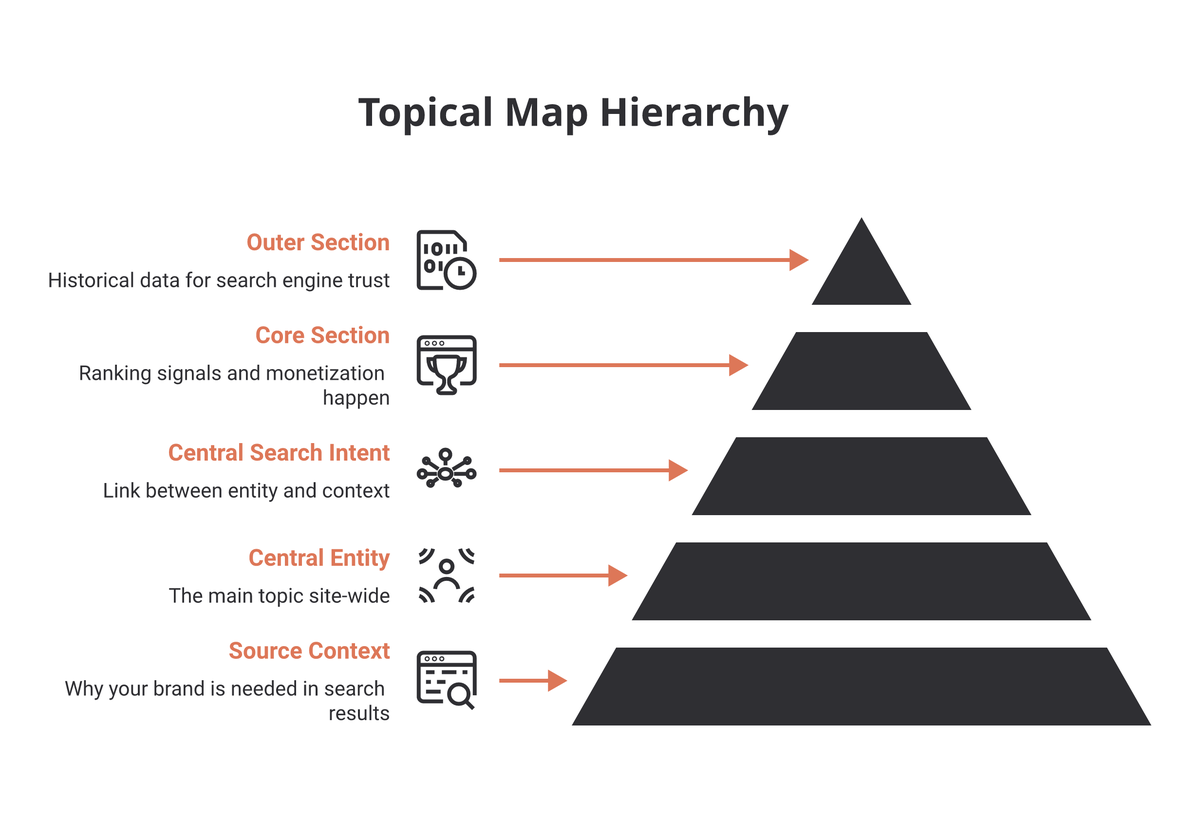
Gubur outlined five key fundamentals for a successful topical map:
- Source Context: Understanding why your brand is needed in the Search Engine Results Pages (SERPs).
- Central Entity: Determining the main topic that appears site-wide.
- Central Search Intent: The connection between the central entity and the source context.
- Core Section of the Topical Map: Where most ranking signals flow and monetization happens.
- Outer Section of the Topical Map: Where historical data comes from, essential for gaining search engine trust.
Practical Examples and Case Studies
Gubur provided several examples from different domains to illustrate how to apply these principles. For instance, he discussed how a health encyclopedia site might structure its topical map, focusing on different aspects of health in the core section and related drug information in the outer section.
Creating a Functioning Topical Map
The creation of a topical map involves three steps:
- Choosing the Right Elements: This includes the source context, central entity, central search intent, core and outer sections of the topical map.
- Using Token Insertion: This method involves taking all probable probabilities of word distributions in a web document and query terms.
- Designing Prioritization and Contextual Weight: This step is about understanding macro and micro contexts and designing the web document template accordingly.
Semantic Content Network and Historical Data
Gubur emphasized the importance of a semantic content network and using historical data for approval as an internal factor. This involves understanding query semantics, choosing contexts, and connecting core section entities’ attributes to outer section entities.
Optimizing for Macro and Micro Contexts
Understanding and adjusting macro and micro contexts for topical map nodes is crucial. Gubur stressed that the macro-context should always bring focus back to the central entity and search intent.
My Take: What This Means for Solo Publishers
Koray’s framework can feel like enterprise-scale theory when you first encounter it — all that vocabulary around source context, token insertion, and semantic content networks. Strip it down and the core insight is this: Google has shifted from rewarding keyword coverage to rewarding entity-level authority. The October 2025 core update validated this publicly, and Koray’s methodology predicted every element of it. Sites built around coherent topical networks outperformed thin, keyword-scattered sites across every niche.
Don’t skip the outer section. Most solo publishers pour everything into commercial pages — the reviews, the roundups, the comparison posts. Koray’s recent case studies make the cost of this clear. A law firm directory site reached $150,000 in traffic value by leaning hard on a semantic content network built around the topical map, with a strong outer section doing the trust-signal heavy lifting. A SaaS client saw 9x traffic growth in one year — driven almost entirely by outer section expansion. If your informational layer is thin, your money pages are building on sand. The shift toward LLM-driven information retrieval amplifies this: AI systems reward content networks over isolated posts, and a sparse outer section is a gap that compounds over time.
Quality Nodes and Trending Nodes translate directly to action. Link your strongest informational pages from your homepage or top-level navigation — those become Quality Nodes that route authority back into your topical map. For Trending Nodes, even one timely piece per quarter can create the query spikes that signal topical freshness to Google. This isn’t abstract: context density thinking and ontology-based SEO both point to the same pattern — depth and interconnection of content matter more than raw volume.
What to skip: The full Koray framework — multi-language topical maps, exact-match sub-domain strategies, structured training programs across 32+ languages — is agency-scale work. The 80/20 version for a solo publisher is three things: define your site’s central entity clearly, build a logical topic hierarchy from that entity, and fill coverage gaps systematically instead of chasing random keyword opportunities. Understanding how Google’s ranking mechanisms actually work helps you prioritize which gaps matter most.
Topical maps aren’t a content hack — they’re a structural strategy. If your site doesn’t have a coherent answer to “what is this site the authoritative source for?”, no amount of tactical SEO compensates. Sort the foundation first, then optimize from there.
The AI-Era Angle: A Topical Map Is a GEO Moat
Koray built this framework to win classical rankings, but its real durability is showing up somewhere he wasn’t optimizing for: AI answers. When you ask ChatGPT, Perplexity, Claude, or Google’s AI Overviews a question, the model doesn’t pull from one page — it retrieves a cluster of passages and decides which sources are trustworthy enough to synthesize and cite. The signal it leans on is exactly what a topical map produces: a site that demonstrably covers an entity completely, not a site with one well-optimized post.
That maps cleanly onto answer-engine optimization (GEO). Two mechanics make the topical-map approach a GEO advantage:
- Topical completeness is how retrieval picks its sources. Answer engines fan a query out into sub-questions and retrieve passages for each. A site whose outer section actually answers the adjacent questions gets pulled in repeatedly across the cluster — which is how a model decides you’re the authority on the entity, not a one-hit page. The thin, money-page-only sites Koray warns against are exactly the ones that never surface in an AI answer.
- The central entity is the unit AI engines reason about. LLMs resolve a query to entities before they retrieve. A site organized around a clearly-defined central entity — Koray’s first fundamental — is legible to that process. Scattered keyword pages with no entity spine are not.
So the reframe is simple: the win condition has shifted from rank #1 to get cited, but the work didn’t change. Topical completeness was the moat against thin competitors in classical Search; it’s now also the moat against being skipped when a model assembles its answer. If anything, the AI-search era raises the cost of a sparse outer section — a gap that merely lost you a ranking before can now keep you out of the answer entirely. Build the map for entity authority and you’re optimizing for both surfaces at once.
Action Items for Implementing Topical Maps
To apply Gubur’s advanced strategies, here are refined action items:
- Develop a Comprehensive Topical Map: Incorporate source context, central entity, and search intent into the topical map.
- Apply Token Insertion Methodology: Use this approach for creating raw and processed topical maps.
- Design Document Templates Based on Context: Focus on creating templates that cater to both macro and micro contexts.
- Leverage Historical Data: Use historical data to inform content creation and improve index prioritization.
- Understand and Apply Query Semantics: Tailor content according to query semantics to bridge the gap between query and document vocabulary.
Conclusion
Koray Tuğberk Gubur’s presentation provides an in-depth understanding of creating and utilizing topical maps for SEO. This blog post, enriched with insights from his slides, offers SEO professionals a detailed roadmap to harness the power of topical maps and achieve topical authority in their respective niches.
Frequently Asked Questions
What is a topical map in SEO?
A topical map is a structural framework for organizing a website so a search engine can understand its authority, not just a list of keywords or topics to target. In Koray Tuğberk Gubur’s methodology, it merges search language with natural language to maximize relevance, organizing a site around a central entity with a core section (where ranking signals and monetization concentrate) and an outer section (which supplies the historical data and trust signals). The goal is topical authority.
What are the key fundamentals of a successful topical map?
Koray Tuğberk Gubur outlines five fundamentals for a successful topical map. They are source context (why your brand is needed in the SERPs), the central entity (the main topic appearing site-wide), central search intent (the link between central entity and source context), the core section (where ranking signals flow and monetization happens), and the outer section (the source of historical data needed to earn search engine trust).
How should a solo publisher apply Koray’s topical map framework?
A solo publisher should use the 80/20 version rather than the full agency-scale framework. Define your site’s central entity clearly, build a logical topic hierarchy from that entity, and fill coverage gaps systematically instead of chasing random keywords. Critically, don’t neglect the outer (informational) section — Koray’s case studies show a thin informational layer leaves your money pages building on sand, while a strong outer section does the trust-signal heavy lifting.
Do topical maps still matter for AI and answer-engine search?
Yes — topical maps are arguably more valuable in AI search, because the work that wins classical rankings is the same work that gets a site cited by answer engines. Models like ChatGPT, Perplexity, and Google’s AI Overviews retrieve a cluster of passages and favor sites that cover an entity completely, not sites with one optimized post. Topical completeness is how retrieval picks its sources, making a topical map a GEO moat; a sparse outer section can now keep you out of the answer entirely.
Sources: Koray Tuğberk Gübür’s presentation “How to Create a Killer Topical Map”; Genghis Digital analysis of the Koray Framework (2025); Koray’s LinkedIn case studies on law firm directory and SaaS topical map performance. Related reading on RankingHacks: LLM-Driven SEO: The Shift to Topical Coverage, Context Density: The SEO Framework Built for AI-Driven Search, Olesia Korobka’s Insights on Next-Gen SEO with Ontology.