Technical Analysis: Unconventional HCU Recovery Using 302 Redirects – A Case Study
In a presentation at a recent SEO conference, Dejan Mladenovski shared his experience recovering a site severely impacted by Google’s Helpful Content Update (HCU). The site, which lost approximately 95% of its traffic post-HCU, achieved full traffic recovery through an unconventional technical SEO a
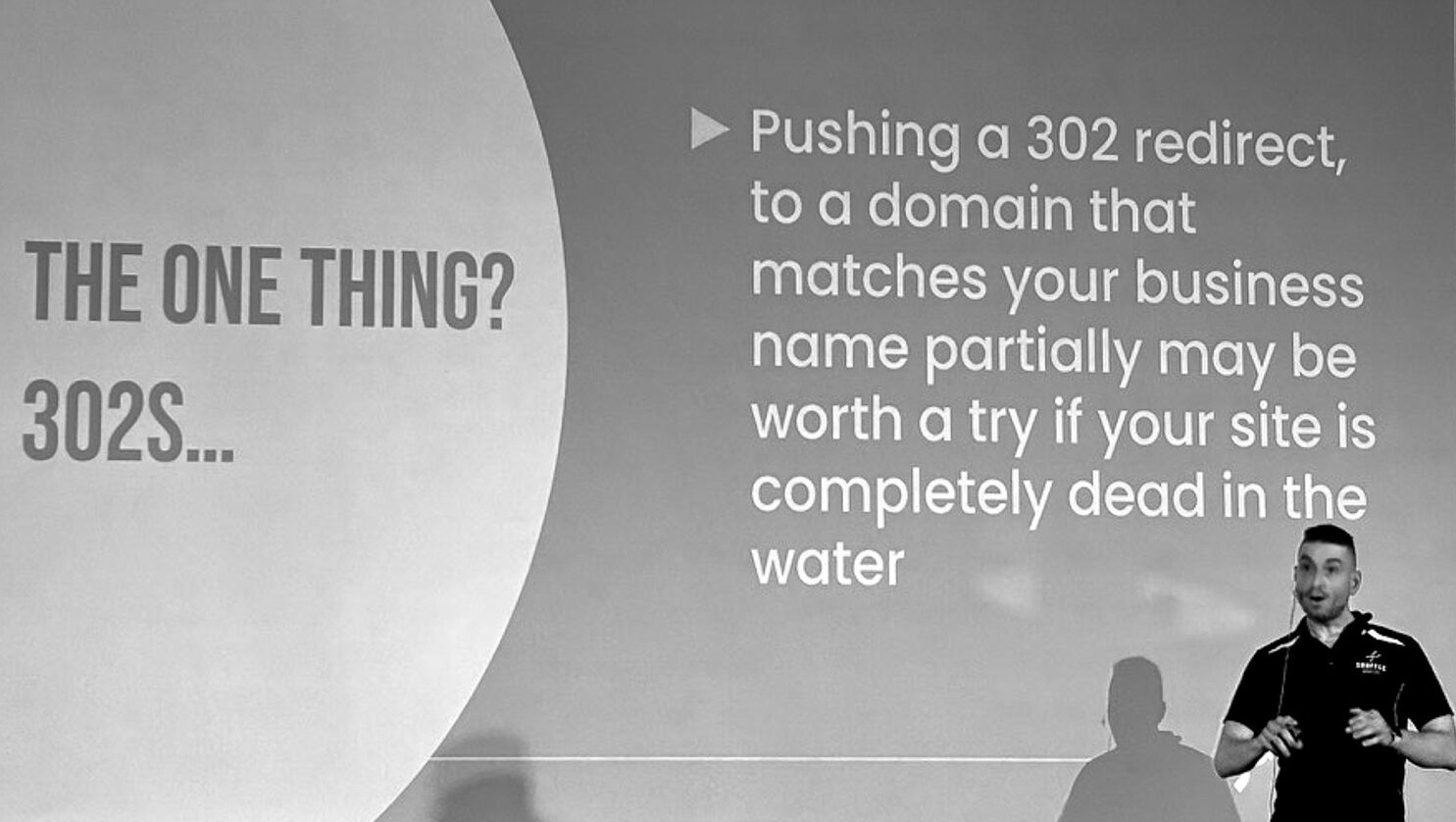
In a presentation at a recent SEO conference, Dejan Mladenovski shared his experience recovering a site severely impacted by Google’s Helpful Content Update (HCU). The site, which lost approximately 95% of its traffic post-HCU, achieved full traffic recovery through an unconventional technical SEO approach using 302 redirects – a method that contradicts standard SEO practices. This recovery occurred three days before Google’s official HCU reversal update, making it particularly noteworthy for sites still struggling with HCU impacts.
Background and Initial Impact
The Site Profile
- Lead generation site with moderate traffic (25,000-30,000 visitors/month)
- Content primarily generated using GPT-3
- Minimal expertise signals and author documentation
- Revenue primarily dependent on SEO traffic
- Approximately 500 pages of content
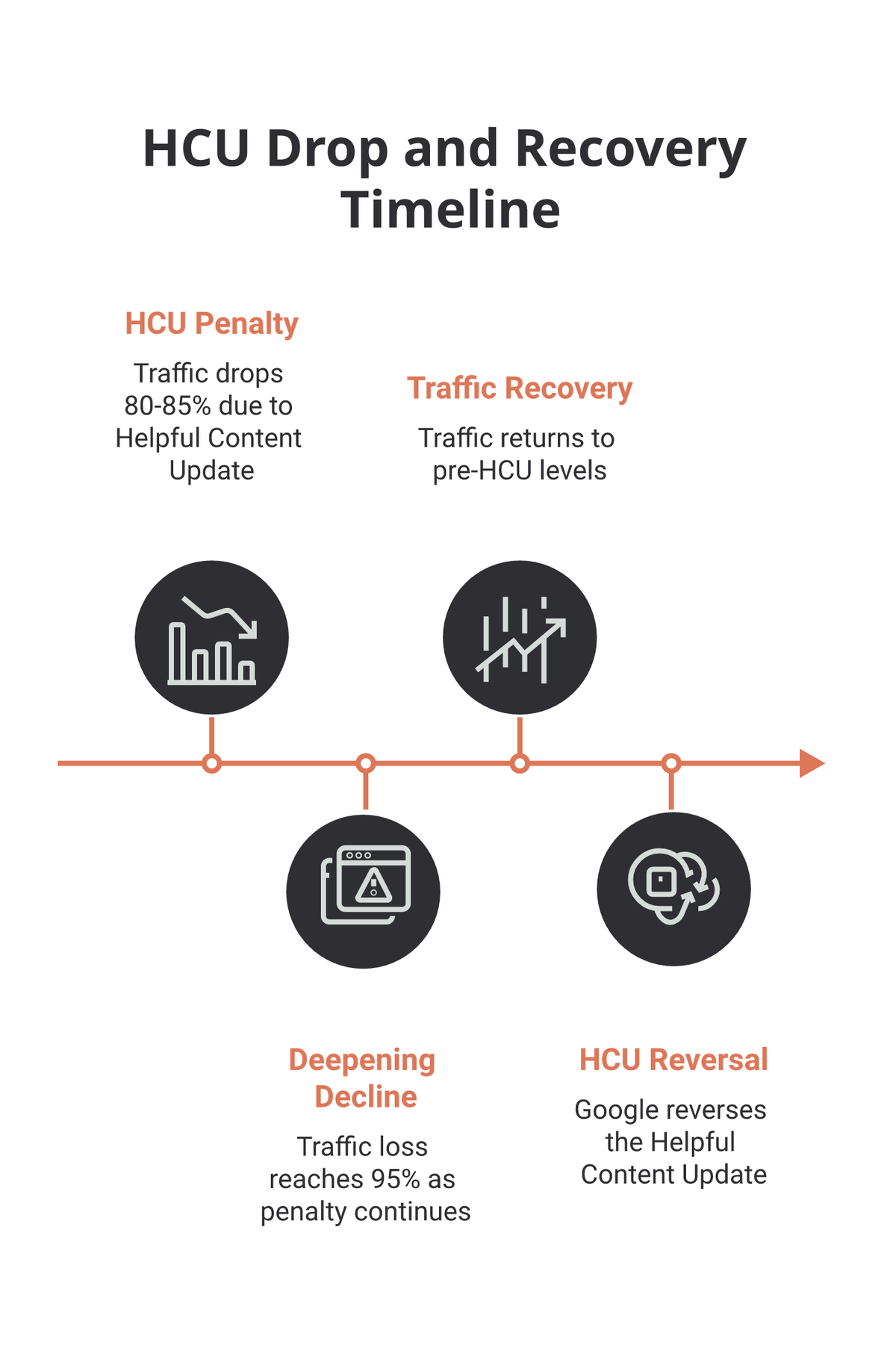
HCU Impact Timeline
- September 2023: Initial HCU hit with 80-85% traffic drop
- March 2024: Further decline to 95% traffic loss
- August 4, 2024: Recovery to pre-HCU traffic levels
- August 7, 2024: Google’s official HCU reversal update
Technical Recovery Strategy
Core Technical Approach
- Domain Migration using 302 Redirects
- Unconventional use of 302 (temporary redirect) instead of standard 301 redirects (permanent redirect)
- One-to-one page mapping for all content
- No new backlink building during migration
- Domain Selection Criteria
- Expired domain containing relevant industry keywords
- Similar geographic top-level domain
- Existing authority and clean link profile
- Previous traffic history in same country
Content Management
- Content Removal
- Eliminated 300 GPT-4 generated pages
- Removed affiliate content pages
- Maintained original GPT-3 content without updates
- Technical Implementation Details
- Maintained same Google Analytics Measurement ID
- Kept identical design and logo
- Retained same email address structure
- No Google Search Console setup on new domain
Analysis of Success Factors
Key Technical Insights
- 302 Redirect Theory
- Temporary redirect status may prevent HCU penalty transfer
- Based on agency migration experience patterns
- Allows for testing without permanent commitment
- Domain Authority Transfer
- Two-hop redirects resulted in 10-20% authority loss
- Maintained partial keyword relevance through domain selection
- Preserved existing backlink profile without new building
Risk Factors and Considerations
- Implementation Risks
- Potential for complete traffic loss
- Resource investment in migration
- Uncertainty of long-term stability
- Technical Debt
- Multiple redirect hops affecting site speed
- Maintenance complexity
- Future migration challenges
Current Testing and Future Implications
Ongoing Experiments
- Redirect Removal Testing
- Systematic removal of redirects every two weeks
- Three-month evaluation period
- Testing authority retention without redirects
- Domain Migration Testing
- Planned migration to third domain
- Testing repeatability of recovery method
- Evaluating long-term viability
Strategic Considerations
- Technical SEO Impact
- Challenges traditional redirect best practices
- Questions permanence of HCU penalties
- Suggests technical workarounds for content penalties
- Long-term Viability
- Uncertainty about future Google updates
- Resource requirements for implementation
- Scalability across different site types
My Take: What This Means for Solo Publishers
This case study is interesting precisely because it violates everything you’ve been told. Every migration guide says use 301 redirects for domain changes—never 302. But in an HCU scenario, that “correct” advice would have transferred the penalty to the new domain, killing the recovery before it started.
Here’s what I think actually happened: the 302 kept Google’s view of the old domain in limbo. The old pages didn’t officially “move”—they just temporarily pointed elsewhere. Meanwhile, the new expired domain got indexed as a fresh entity without carrying the HCU classification. Google has confirmed both 301 and 302 redirects pass PageRank, but in this setup the penalty flag didn’t transfer with it. Understanding how Google’s ranking mechanisms actually work under the hood makes this less surprising—HCU penalties appear to be domain-level classifications, not content-level ones, so landing on a clean domain sidesteps the label entirely.
What I’d actually implement from this:
- Domain selection is the hard part. Finding an expired domain with real prior traffic in your niche is weeks of work. A random aged domain won’t replicate these results—the relevance and clean authority of the target domain are doing most of the heavy lifting.
- The 302 is deliberate, not lazy. You’re specifically exploiting the fact that 302s signal a temporary move, so Google doesn’t treat it as a permanent site merger and doesn’t carry over entity-level flags.
- Baseline everything before you touch anything. Logic and systematic testing in SEO matters here—document rankings, impressions, and crawl data on both domains before the migration, or you’ll have no way to isolate what actually moved the needle.
- Frame it as a high-risk play on a dead asset. Think of this like an SEO portfolio decision—the old domain is already worthless at 95% traffic loss. If the new domain also fails, the downside is essentially zero. That changes the risk calculus significantly compared to migrating a healthy site.
What to ignore: the details about keeping the same GA Measurement ID and skipping GSC setup on the new domain. Interesting observations, but not what drove the recovery. Don’t cargo-cult the peripheral implementation details.
The elephant in the room: this recovery happened 3 days before Google’s own HCU reversal update. We’ll never know how much was the 302 technique versus Google already rolling back the penalty internally. That uncertainty doesn’t invalidate the case study—domain-level authority signals clearly matter independently of algorithm timing—but it should calibrate your expectations. If you try this and it works, great. If it doesn’t, the timing variable is as plausible an explanation as the redirect type. For solo publishers fully dependent on organic, building parallel traffic channels remains the more reliable long-term hedge than domain migration tricks.
The AI-Era Angle: “Helpful Content” Now Means LLM-Extractable
Step back from the redirect mechanics and look at what HCU was actually measuring. The Helpful Content system was Google’s attempt to classify, at the domain level, whether a site exists to help a human or to game a ranking. The 302 trick here is a technical workaround that dodges that classification — it doesn’t make the underlying content any more helpful, it just lands it on a domain that never carried the flag. Which is exactly why it’s a fragile, high-risk play and not a strategy: you’re sidestepping the judgment, not satisfying it.
Now move that same judgment into answer-engine optimization (GEO). When ChatGPT, Perplexity, Claude, or Google’s AI Overviews assemble an answer, they’re running a near-identical filter — but there is no domain-level penalty flag to dodge. A model retrieves passages and decides, per passage, whether the content is clear, self-contained, and trustworthy enough to lift into its answer. The site built on 500 pages of un-updated GPT-3 content with minimal expertise signals — the exact profile that got hit by HCU — is the same site an LLM skips when it has cleaner sources to cite. There’s no 302 that fixes that, because the “penalty” isn’t a label attached to a domain; it’s the model simply not choosing you.
So the durable read on this case study, in the AI era:
- The redirect play has a shorter shelf life than ever. HCU recovery via a clean domain only buys time if the content is genuinely extractable. An answer engine re-evaluates the content on every retrieval — it doesn’t inherit a “this domain is fine now” verdict the way a classical re-crawl might.
- “Helpful” and “citable” are converging into one signal. What HCU tried to score — does this answer a real question well — is precisely what determines whether a passage gets quoted in an AI Overview. Optimizing for one now optimizes for the other. Thin, expertise-light content fails both surfaces simultaneously.
- The real HCU recovery is making the content liftable. Clear claims, self-contained sections, visible authorship and expertise, genuine first-hand judgment — the parallel-channel diversification play hedges the click, but the on-page fix that survives both a Google classifier and an LLM retriever is the same fix: content a machine can confidently extract and attribute.
The reframe: in 2024 you could treat an HCU hit as a redirect puzzle. In the AI-search era, the win condition has shifted from clear the penalty to be the passage the model cites — and there’s no temporary redirect that wins that one for you. You earn it by being extractable.
Action Items for SEO Practitioners
- Assessment Phase
- Evaluate traffic patterns matching HCU impact timeline
- Audit content quality against Google’s helpful content guidelines
- Analyze current redirect and domain structure
- Technical Preparation
- Identify suitable expired domains meeting selection criteria
- Map out complete redirect structure
- Prepare monitoring and measurement framework
- Implementation Considerations
- Document all current site metrics and baselines
- Create rollback plan for potential issues
- Set up comprehensive tracking across both domains
- Risk Mitigation
- Maintain original domain and structure
- Phase implementation if possible
- Monitor key performance indicators daily
- Long-term Strategy
- Plan for potential future migrations
- Develop content quality improvement roadmap
- Build authority signals on new domain
Critical Limitations and Caveats
- Case Study Specifics
- Single site example
- Specific niche and content type
- Unique timing relative to Google updates
- Implementation Risks
- No guarantee of similar results
- Resource-intensive process
- Potential for complete traffic loss
- Long-term Uncertainties
- Future Google algorithm updates
- Scalability across different sites
- Maintenance requirements
Conclusion
This case study presents a novel technical SEO approach to recovering from the HCU update through strategic use of 302 redirects and domain migration. While the method shows promise, it requires careful consideration of implementation risks and resource requirements. The ongoing testing and future implications suggest this could be a valuable addition to the technical SEO recovery toolkit, particularly for sites severely impacted by content-based penalties.
This approach challenges traditional SEO best practices regarding redirect usage and raises important questions about the nature of Google’s helpful content system. As with any technical SEO strategy, practitioners should carefully evaluate their specific situation and resources before implementing similar measures.
The success of this case study suggests that technical SEO solutions may still be viable for content-based penalties, though long-term sustainability remains to be proven. Continued monitoring of the test cases and future Google updates will be crucial for understanding the broader applicability of this approach.
Frequently Asked Questions
What is the Helpful Content Update (HCU)?
The Helpful Content Update (HCU) was Google’s attempt to classify, at the domain level, whether a site exists to help a human or to game a ranking. In this case study, the affected site lost roughly 95% of its organic traffic after being hit, dropping from moderate traffic to almost nothing. The penalty behaved like a domain-level classification rather than a content-level one, which is what made the eventual recovery approach possible.
What is a 302 redirect, and why use it instead of a 301 here?
A 302 redirect signals a temporary move, whereas a 301 signals a permanent one. In this HCU recovery case study, Dejan Mladenovski used 302 redirects to migrate to an expired domain precisely because the temporary status appeared to prevent the HCU penalty from transferring with the move. A standard 301 would likely have carried the domain-level penalty flag onto the new domain, killing the recovery before it started.
How did the 302 redirect recovery approach actually work?
The recovery migrated all content one-to-one to a carefully chosen expired domain using 302 redirects, with no new backlink building. The expired domain had relevant industry keywords, prior traffic history in the same country, and a clean link profile, which did most of the heavy lifting. The site also removed 300 GPT-4 pages and affiliate content. The new domain got indexed as a fresh entity that never carried the HCU classification, restoring traffic to pre-HCU levels.
Does this 302 redirect trick still work in the AI-search era?
The 302 redirect play has a shorter shelf life than ever in the AI era. It dodges Google’s domain-level penalty classification, but answer engines like ChatGPT, Perplexity, and AI Overviews have no domain flag to evade — they re-evaluate the actual content on every retrieval, deciding per passage whether it is clear, self-contained, and citable. Thin, expertise-light content fails both surfaces, so the durable fix is making content genuinely extractable rather than relying on a redirect.
Sources: Dejan Mladenovski’s conference presentation on HCU recovery (2024). Related reading on RankingHacks: Lily Ray’s breakdown of the Helpful Content Update, Google’s ranking mechanisms explained, and logic and testing in SEO.