Michal Suski’s Guide to Building Authority with AI Content
In an insightful presentation, Michal Suski delved into the strategic use of AI in content creation to build authority and achieve substantial growth. This blog post transforms his talk into a compelling narrative, highlighting the importance of a proper strategy, the need for quality data in AI, an

In an insightful presentation, Michal Suski delved into the strategic use of AI in content creation to build authority and achieve substantial growth. This blog post transforms his talk into a compelling narrative, highlighting the importance of a proper strategy, the need for quality data in AI, and the advantages of using premium AI engines for content creation.
Implementing the Right Content Strategy for AI Success
Suski emphasized the significance of a well-thought-out content strategy in leveraging AI. He advocated for keyword clustering to identify content gaps and create comprehensive interlinked content silos, rather than optimizing on a page-by-page basis. Tools like Surfer SEO and SERP API were recommended for analyzing millions of keywords to construct an authoritative site structure effectively.
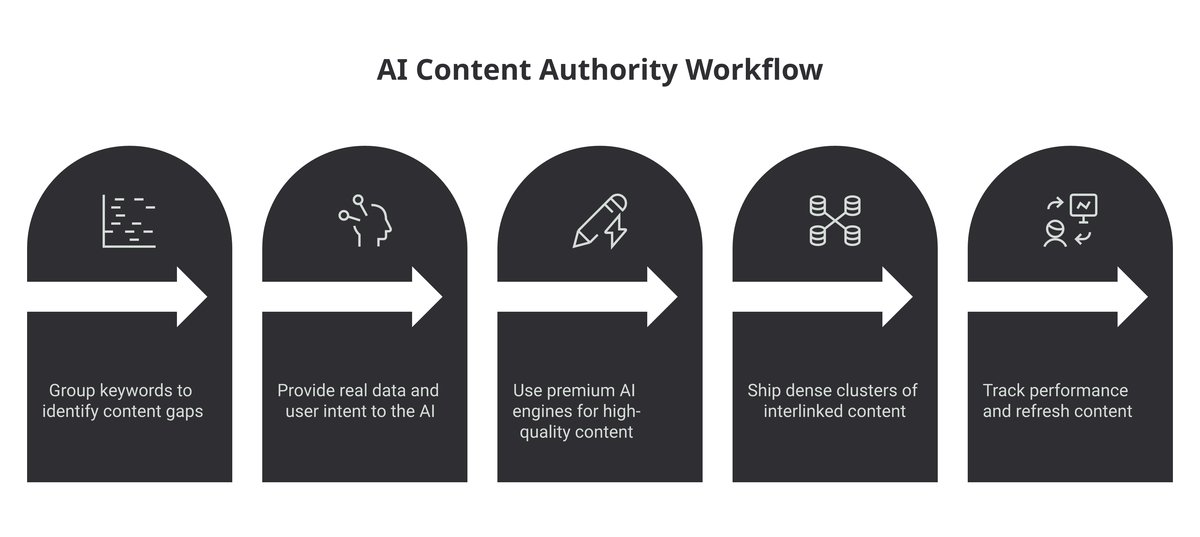
AI Needs Relevant Data and Intent to Create Optimized Content
A key takeaway from Suski’s presentation was that feeding AI with just competitor content isn’t sufficient. For AI to generate useful content, it requires relevant facts, topics, and user intent. He suggested using tools like Surfer AI and SERP API to analyze top-ranking content, extract essential information, and build a robust knowledge base.
Premium AI Engines Are Essential for High-Quality Content
Suski highlighted the pitfalls of using cheaper AI options, which often lead to low-quality content full of repetitions and poor optimization. He advocated for premium AI solutions with large datasets and advanced prompt engineering, like Surfer AI, which uses 400k tokens and analyzes 300k words per article, to produce high-quality content that requires minimal editing.
Publishing Interlinked AI Content Silos Leads to Impressive Growth
Illustrating the effectiveness of this strategy, Suski presented case studies showing that publishing clusters of interlinked AI articles can lead to dramatic growth. He cited an example of a marketing site that achieved an 11x increase in traffic in just two months by adopting this approach.
AI Doesn’t Inherently Cause Google Penalties
Addressing a common misconception, Suski presented a case study of a site that recovered from a Google penalty by replacing its content with high-quality AI-generated material from Surfer AI. This example served to debunk the myth that AI usage leads to penalties, pointing instead to the quality of the AI as the critical factor.
My Take: What This Means for Solo Publishers
Suski’s framework is genuinely solid — but it was built for teams with real tool budgets. Here’s the translation for solo publishers running affiliate or niche content sites in 2026.
The silo strategy is more critical now, not less. With AI Overviews absorbing a growing share of clicks on informational queries, ranking a single page isn’t enough. Google’s chunk-ranking system means your topical authority — not a single URL — determines whether you get cited. Isolated pages don’t get cited; dense interlinked clusters do. Suski was right about this even before AI Overviews made it the default rule.
Feed your AI actual context, not just competitor content. If you dump competitor pages into ChatGPT or Claude, you get competent-but-generic output. What moves the needle is first-party context: your own test data, niche-specific facts competitors don’t have, original observations. This is the core of LLM content optimization done right — and it’s what separates content that gets cited from content that gets scrolled past.
On the premium AI question: in 2026, the gap between cheap and premium AI output has narrowed at the prose level, but it’s wider than ever at the context level. Any model can write clean sentences. The real differentiator is context density — the richness and specificity of what you feed in. Surfer AI’s 300k-word analysis per article is overkill for a solo site. Focus on context quality over model selection.
What to skip from Suski’s list: “build custom tools” and “work closely with AI experts.” That’s agency advice. For solo publishers, programmatic SEO with off-the-shelf AI tools gets you 80% of the result at 10% of the overhead. Pair it with a disciplined content reoptimization cadence — systematic refresh beats new production at almost every traffic tier under 100k monthly visits.
Bottom line: pick 3-5 cluster topics you can credibly own, build 8-12 posts per cluster, interlink aggressively, and refresh the cluster every quarter. That’s the solo-publisher version of Suski’s playbook — no agency budget required.
Action Items for Leveraging AI in Content Creation
Based on Suski’s insights, here are actionable steps for effectively using AI in content strategy:
- Keyword Research: Utilize tools like Surfer SEO or SERP API to research millions of keywords, identify content gaps, and develop a strategic site structure.
- Data Analysis for AI: Analyze the top 10 search results to gather key facts, topics, and user intent, creating a knowledge base for AI content generation.
- Choose Premium AI Solutions: Opt for high-quality AI like Surfer AI for generating optimized content.
- Publish Interlinked Content Silos: Focus on publishing interlinked clusters of AI content in comprehensive categories for growth.
- Recover from Google Penalties: Use high-quality AI content to replace inferior material and recover from potential penalties.
- Monitor and Iterate: Continuously monitor search performance and iteratively improve AI content.
- Utilize AI’s Style Capabilities: Communicate clearly in an AI’s style to get the best output.
- Technical Collaboration: Work closely with AI experts, like Surfer’s CTO, to understand prompt engineering for AI.
- Automate Processes: Consider automating data analysis and content generation as much as possible.
- Stay Updated with AI Developments: Keep exploring the latest AI engines like GPT-4 for content creation.
- Develop Custom Tools: Build your own tools and frameworks for streamlined AI content production.
Conclusion
Michal Suski’s presentation offers a comprehensive roadmap for businesses and content creators looking to harness the power of AI for building authority and driving growth. By following these strategies and action items, one can effectively integrate AI into their content strategy, ensuring quality, relevance, and substantial growth in their digital presence.
Sources: Michal Suski’s presentation on AI content strategy and authority building. Related reading on RankingHacks: AI-Driven Content Strategy, LLM Content Optimization, Context Density SEO Framework.